Different Types of Home Theater Systems Explained: Which One Is Right for You?
A great movie night is about more than having a large television. The right home theater system can transform an ordinary living room into an immersive entertainment space where dialogue feels clearer, sound effects have depth, music feels more natural, and every scene becomes more engaging.
However, choosing a home theater system can be confusing. Should you choose a soundbar or a full surround sound setup? Is a 5.1 system enough, or should you consider Dolby Atmos? Would a dedicated media room benefit from a more advanced AV receiver and speaker configuration?
The answer depends on your room size, listening preferences, budget, content, and how immersive you want your entertainment experience to be.
At SoundTrails, the focus is not simply on adding more speakers. It is about creating a balanced audio experience where speakers, amplification, acoustics, subwoofers, and the room work together.
In this guide, we explain the different types of home theater systems, how they work, their advantages and limitations, and how to determine which configuration is right for your home.
What Is a Home Theater System?
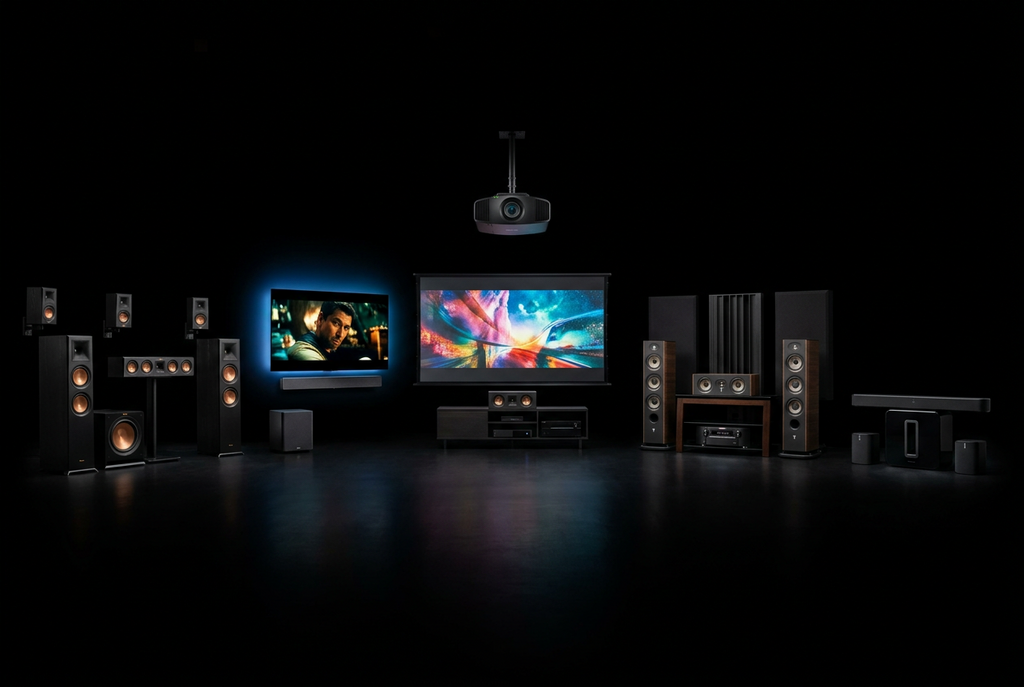
A home theater system is a combination of audio and video components designed to recreate the immersive experience of a cinema within a residential space.
A typical setup may include:
-
A television or projector and screen
-
Front left and right speakers
-
A center channel speaker
-
Surround speakers
-
One or more subwoofers
-
An AV receiver or processor
-
Power amplifiers, depending on the system
-
Streaming or Blu-ray sources
-
Dolby Atmos or other surround-sound processing
The complexity of the system can range from a compact soundbar to a fully integrated multi-channel cinema room.
The important point is that there is no universally "best" home theater system. The right system is the one that matches your room, content consumption, and listening priorities.
Different Types of Home Theater Systems
1. Soundbar-Based Home Theater
A soundbar is one of the simplest ways to improve the audio from a television.
Instead of installing several separate speakers, a soundbar combines multiple speaker drivers into one compact enclosure. Many modern soundbars also support wireless subwoofers and surround speakers.
Best for:
-
Apartments
-
Smaller rooms
-
Minimalist interiors
-
Simple installations
-
Casual movie and TV viewing
Advantages
-
Easy installation
-
Minimal wiring
-
Compact design
-
Better dialogue and sound than most built-in TV speakers
-
Suitable for rooms where multiple speakers are impractical
Limitations
A soundbar generally cannot reproduce the same scale, separation, soundstage, and spatial precision as a properly positioned multi-speaker system.
If your priority is convenience, a soundbar can be an excellent choice. If you want a true cinematic experience, however, you may want to explore a dedicated surround setup.
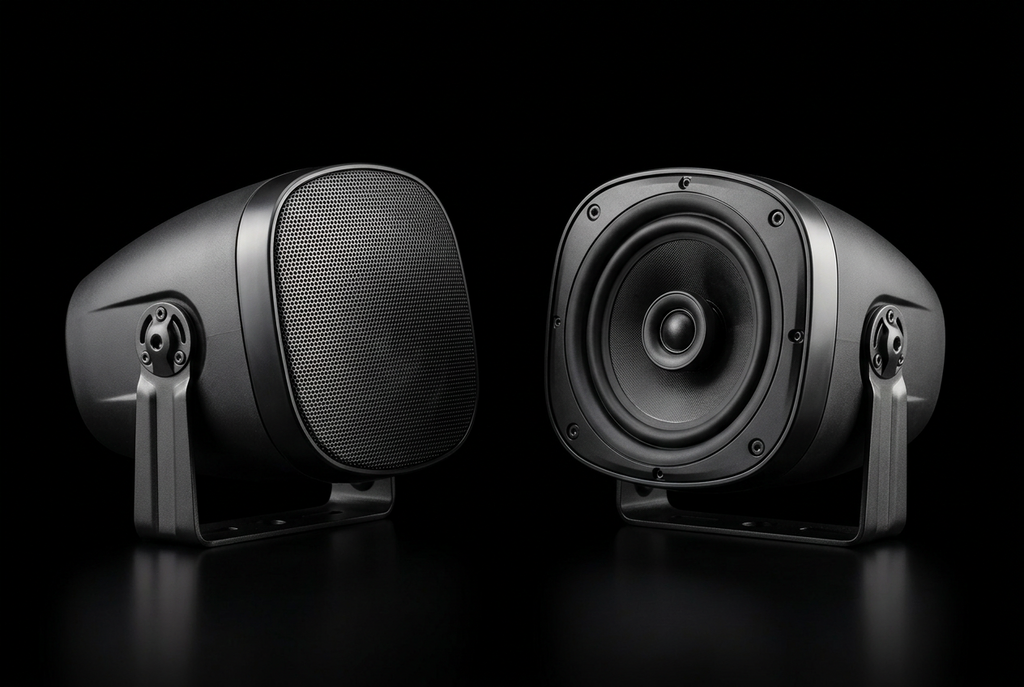
2. 2.0 Stereo Home Theater System
A 2.0 setup consists of two main speakers, usually positioned to the left and right of the display.
While it may not look like a conventional surround-sound system, a well-designed stereo setup can produce an exceptionally engaging experience.
For people who enjoy both movies and music, this configuration can be particularly appealing.
Best for:
-
Music enthusiasts
-
Smaller rooms
-
Audiophile listening
-
Movies with strong dialogue and musical scores
-
Users who prefer simplicity
A high-quality stereo setup can deliver excellent imaging and a convincing soundstage without requiring multiple speakers around the room.
3. 2.1 Home Theater System
A 2.1 configuration adds a dedicated subwoofer to the two main speakers.
The "2" represents the left and right speakers, while the ".1" represents the subwoofer channel.
The addition of a subwoofer can significantly improve the sense of scale.
Explosions, cinematic scores, action sequences, bass-heavy music, and low-frequency sound effects can have considerably more impact.
Best for:
-
Small and medium-sized rooms
-
Music and movie enthusiasts
-
Users who want strong bass without multiple surround speakers
-
Compact premium setups
A carefully integrated subwoofer should not simply produce more bass. It should blend with the main speakers and extend the system's low-frequency performance naturally.
4. 5.1 Surround Sound System
The 5.1 system is one of the most familiar home theater configurations.
It typically includes:
-
Front left speaker
-
Front right speaker
-
Center speaker
-
Surround left speaker
-
Surround right speaker
-
Subwoofer
The center channel is particularly important for dialogue because it anchors voices to the screen.
The surround speakers add environmental sounds and effects, creating greater immersion than a stereo system.
Best for:
-
Dedicated movie viewing
-
Medium-sized rooms
-
Families
-
Gaming
-
Streaming movies and series
A well-positioned 5.1 system can create a dramatic improvement in immersion without requiring the complexity of a larger Dolby Atmos installation.
5. 7.1 Surround Sound System
A 7.1 system builds upon the 5.1 configuration by adding two additional surround speakers.
The result is greater separation and a more enveloping sound field.
A traditional 7.1 system includes:
-
Front left
-
Front right
-
Center
-
Surround left
-
Surround right
-
Rear surround left
-
Rear surround right
-
Subwoofer
Best for:
-
Larger rooms
-
Dedicated home theaters
-
Users who want greater surround coverage
-
People who watch a lot of action and cinematic content
However, adding speakers does not automatically mean better sound. Speaker placement, room acoustics, calibration, and appropriate amplification remain critical.
6. Dolby Atmos Home Theater
Dolby Atmos takes surround sound further by adding a sense of vertical dimension.
Traditional surround systems primarily distribute sound around the listener. Dolby Atmos can also create the perception of sound coming from above.
This is particularly effective for:
-
Aircraft flying overhead
-
Rain
-
Thunder
-
Atmospheric effects
-
Large-scale action sequences
-
Immersive movie soundtracks
An Atmos setup may use dedicated ceiling speakers or upward-firing speakers, depending on the room and installation.
Why choose Dolby Atmos?
If immersive cinema is your priority, Dolby Atmos can create a more three-dimensional listening experience.
However, the effectiveness of an Atmos system depends heavily on room dimensions, speaker placement, ceiling characteristics, calibration, and content compatibility.
7. Projector-Based Home Theater
A projector-based system focuses on creating a large cinematic image, often paired with a dedicated surround sound system.
Instead of using a television, the setup may include:
-
Projector
-
Projection screen
-
AV receiver
-
Multiple speakers
-
Subwoofer
-
Streaming device
-
Media player or gaming console
This configuration is particularly attractive for people who want the scale of a cinema in their home.
Best for:
-
Dedicated media rooms
-
Large living spaces
-
Movie enthusiasts
-
Sports viewing
-
Gaming
-
Large-format entertainment
The projector should not be selected independently from the room. Throw distance, screen size, ambient light, viewing distance, and projector brightness all influence the final result.
8. Dedicated Home Cinema
A dedicated home cinema is the most comprehensive option.
Instead of simply placing speakers and a display inside an existing room, the entire environment can be designed around the viewing and listening experience.
A dedicated cinema may include:
-
Acoustic treatment
-
Dedicated projector and screen
-
Multiple speakers
-
Dolby Atmos
-
Multiple subwoofers
-
AV processor
-
Separate power amplification
-
Cinema seating
-
Lighting control
-
Smart-home integration
This type of system is designed for users who want a highly immersive entertainment environment.
The biggest advantage is that every element can be considered as part of a single system.
9. Wireless Home Theater Systems
Wireless technology has made home theater installation considerably more flexible.
Wireless rear speakers and subwoofers can reduce the amount of visible cabling, making them particularly useful in finished interiors.
However, "wireless" does not necessarily mean completely cable-free.
Some components still require power connections, and wireless performance can depend on network quality and the specific products being used.
Best for:
-
Modern interiors
-
Apartments
-
Users who want reduced visible cabling
-
Flexible speaker placement
For a premium installation, reliability and performance should take priority over simply minimizing wires.
How Do You Choose the Right Home Theater System?
The best home theater configuration depends on several factors.
1. Consider Your Room Size
Room dimensions have a major impact on speaker selection and placement.
A compact room may work beautifully with a 2.1 or 5.1 system, while a larger dedicated room may justify 7.1, Dolby Atmos, multiple subwoofers, or more powerful amplification.
Installing too many speakers in a small room can actually make the system more complicated without producing meaningful benefits.
2. Think About What You Watch
Your content habits should influence your setup.
If you mainly watch:
TV shows and streaming content:
A high-quality stereo, soundbar, or 3.1 setup may be sufficient.
Movies:
A 5.1 or Dolby Atmos system can provide a more immersive experience.
Action films:
A capable subwoofer and surround speakers can make a substantial difference.
Music:
A high-quality stereo system may be more appropriate than simply adding more surround channels.
Gaming:
Spatial audio and precise speaker positioning can improve environmental awareness and immersion.
3. Don't Ignore the Center Channel
The center speaker is often one of the most important components in a traditional home theater.
It handles much of the dialogue and helps anchor voices to the screen.
A weak or poorly matched center speaker can result in dialogue that sounds thin, unclear, or disconnected from the rest of the system.
For this reason, speaker matching across the front soundstage is an important consideration.
4. Choose the Right Subwoofer
A subwoofer is responsible for reproducing low-frequency information that smaller speakers may struggle to deliver.
But bigger bass is not always better.
A properly selected and positioned subwoofer should provide:
-
Depth
-
Impact
-
Control
-
Integration
-
Consistency across the listening area
Room acoustics can significantly affect bass performance. In larger rooms, multiple subwoofers may sometimes provide more consistent bass distribution than a single larger unit.
5. Room Acoustics Matter
Even expensive equipment can perform poorly in an untreated room.
Hard surfaces such as glass, tile, and bare walls can create unwanted reflections. Excessive reflections can reduce clarity and make the sound feel less precise.
Acoustic treatment can help control:
-
Reflections
-
Reverberation
-
Bass irregularities
-
Dialogue clarity
-
Soundstage definition
This is why professional home theater design considers the room and equipment together.
Home Theater in Gurgaon: What Should You Consider?
For homeowners looking for Home Theater in Gurgaon, the first step should be evaluating the available space rather than immediately choosing equipment.
Gurgaon homes range from compact apartments to larger independent residences and luxury properties, meaning there is no one-size-fits-all configuration.
A professional assessment can consider:
-
Room dimensions
-
Seating position
-
Screen size
-
Speaker placement
-
Existing furniture
-
Acoustic characteristics
-
Wiring requirements
-
Lighting
-
Integration with the interior
-
Future upgrade possibilities
For smaller living rooms, a carefully designed stereo, 2.1, 3.1, or compact surround system may be appropriate.
For dedicated entertainment rooms, a 7.1 or Dolby Atmos configuration can provide significantly greater immersion.
Home Theater in Faridabad: Which Setup Makes Sense?
If you are exploring Home Theater in Faridabad, the same principle applies: choose the system according to the room rather than simply selecting the largest configuration available.
For a living-room installation, a compact surround system may offer the right balance between performance and practicality.
For a dedicated entertainment space, a larger multi-channel system with a projector, screen, multiple speakers, and subwoofer can create a much more immersive experience.
The key is system integration.
Should You Choose More Speakers or Better Speakers?
This is one of the most common questions when designing a home theater.
The answer is usually: prioritize the quality and integration of the entire system before simply increasing the number of channels.
A well-designed 5.1 system can sound significantly better than a poorly configured 7.1 system.
Factors such as:
-
Speaker quality
-
Amplifier matching
-
Speaker placement
-
Room acoustics
-
Subwoofer integration
-
Calibration
-
Listening position
can have a major influence on the final experience.
Common Home Theater Mistakes to Avoid
Buying Based Only on Wattage
Higher wattage does not automatically mean better sound.
Sensitivity, impedance, amplifier quality, speaker design, room size, and listening distance all matter.
Ignoring Speaker Placement
Even excellent speakers can underperform when placed incorrectly.
Choosing an Oversized System
More components are not always better.
Underestimating the Subwoofer
Low-frequency performance contributes significantly to cinematic impact.
Ignoring Acoustics
The room is part of the audio system.
Mixing Components Without Considering Compatibility
A home theater should be treated as a complete system rather than a collection of unrelated products.
Home Theater vs Soundbar: Which Is Better?
There is no universal winner.
|
Feature |
Soundbar |
Multi-Speaker Home Theater |
|
Installation |
Simple |
More involved |
|
Space requirement |
Low |
Moderate to high |
|
Surround immersion |
Moderate |
High |
|
Music performance |
Depends on model |
Potentially excellent |
|
Upgrade flexibility |
Limited |
High |
|
Speaker separation |
Limited |
Excellent |
|
Cinema experience |
Good |
Excellent with proper design |
|
Customization |
Limited |
Extensive |
If convenience is your priority, a soundbar can be the sensible choice.
If immersion, soundstage, upgradeability, and high-fidelity performance are more important, a dedicated speaker-based system is worth considering.
Why Professional Home Theater Design Matters
Home theater is not simply about purchasing expensive equipment.
The final experience depends on how the components work together.
A professional approach can help determine:
-
The appropriate speaker configuration
-
The correct display size
-
Suitable amplifier power
-
Subwoofer requirements
-
Speaker placement
-
Acoustic treatment
-
Cable management
-
Calibration
-
Smart-home integration
-
Future upgrade options
This system-level approach can prevent expensive mistakes and help ensure that every component contributes to the final listening experience.
Which Home Theater System Is Right for You?
Here is a simplified starting point:
Choose a Soundbar if:
You want simplicity, minimal installation, and better TV audio.
Choose 2.1 if:
You want strong stereo performance with deeper bass in a compact space.
Choose 5.1 if:
You want a traditional and immersive surround experience.
Choose 7.1 if:
You have a larger room and want greater surround coverage.
Choose Dolby Atmos if:
You want a more three-dimensional cinematic experience.
Choose a Dedicated Home Cinema if:
You want the highest level of immersion and are willing to design the room around the experience.
Final Thoughts
The best home theater system is not necessarily the one with the most speakers, the largest subwoofer, or the highest specification sheet.
It is the system that is correctly matched to your room, your content, your listening preferences, and your expectations.
A compact 2.1 system can be exceptional when properly designed. A well-calibrated 5.1 system can deliver an impressive cinema experience. And a carefully engineered Dolby Atmos theater can take home entertainment to an entirely different level.
For anyone considering a Home Theater in Faridabad, professional system planning can make the difference between simply owning home theater equipment and actually experiencing a convincing home cinema.
SoundTrails approaches home audio as a complete experience, helping you select and integrate the right combination of speakers, amplification, source components, subwoofers, and room considerations for your space.
Frequently Asked Questions
What is the best home theater system for a living room?
A 2.1, 3.1, or 5.1 system can work well in a living room depending on its size, layout, and listening requirements. A professional assessment can help determine the most suitable configuration.
Is 5.1 better than a soundbar?
A properly installed 5.1 system generally offers better speaker separation and surround immersion than a soundbar. However, a good soundbar can be more practical for smaller rooms and simpler installations.
Is Dolby Atmos worth it for a home theater?
Dolby Atmos can be worthwhile if you want a more immersive, three-dimensional sound experience and your room allows suitable speaker placement.
How many speakers do I need for a home theater?
There is no fixed number. A system can range from two speakers plus a subwoofer to a much larger multi-channel configuration. Room size, content, and desired immersion should determine the number.
Does room size affect home theater performance?
Yes. Room dimensions, seating position, ceiling height, reflections, and bass behavior all influence how a home theater performs.
Do I need a projector for a home theater?
No. A high-quality television can work extremely well. Projectors are particularly attractive when you want a very large cinematic image or have a dedicated media room.
Can a home theater also be used for music?
Absolutely. A thoughtfully designed system can provide an excellent experience for movies, music, gaming, and streaming. For serious music listening, speaker and amplifier selection becomes especially important.
Latest Posts
29
Oct