Best Turntables for Audiophiles: What Really Matters for Sound Quality
For an audiophile, choosing a turntable is not simply about finding a stylish record player. The right turntable is part of a carefully balanced analogue audio system where the cartridge, tonearm, platter, phono stage, isolation, and setup all influence the final sound.
A well-designed turntable can reveal details in a vinyl recording that are easy to miss with a poorly matched or incorrectly adjusted setup. It can deliver better stereo imaging, tighter bass, smoother treble, improved dynamics, and a more convincing sense of space.
For listeners exploring turntables in Gurgaon, the important question is therefore not just which model looks impressive or has the highest price. The better question is: Which turntable is engineered to extract the most musical information from my records and work properly with the rest of my system?
At SoundTrails, the focus should always be on helping listeners understand these differences before making an investment.
What Makes a Turntable Good for Audiophile Listening?
A turntable's job appears straightforward: rotate a vinyl record at a precise speed while allowing a cartridge to trace the microscopic information contained in its grooves.
In practice, achieving this consistently requires careful engineering.
A quality audiophile turntable should provide:
-
Accurate and stable platter rotation
-
Low mechanical noise
-
Effective vibration control
-
A well-designed tonearm
-
Precise cartridge alignment
-
Appropriate tracking force
-
Good resonance management
-
Reliable speed stability
-
A suitable phono stage or external phono preamplifier
-
Strong compatibility with the amplifier and speakers
The goal is not simply to make the record louder. It is to retrieve the musical information stored in the groove as accurately as possible.
Direct Drive vs Belt Drive Turntables
One of the first specifications buyers encounter is the drive system.
Belt Drive Turntables
In a belt-drive design, the motor is mechanically separated from the platter through a belt.
This approach can help isolate the platter and cartridge from certain motor vibrations. Many audiophile turntables use belt-drive mechanisms because of their potential for excellent isolation and low mechanical interference.
However, implementation matters more than the label itself. A poorly engineered belt-drive turntable will not automatically outperform a well-designed direct-drive model.
Direct Drive Turntables
With direct drive, the platter is connected directly to the motor.
This design can provide excellent speed stability and fast rotational control. High-quality direct-drive turntables are particularly valued for their precise speed regulation and robust engineering.
For home audiophile listening, both technologies can produce excellent results.
The better choice depends on the overall engineering rather than the drive type alone.
Why Speed Stability Matters
Vinyl records contain musical information that depends on precise rotational speed.
If the platter rotates too quickly or too slowly, pitch changes. If the speed fluctuates continuously, listeners may perceive subtle instability in sustained notes, vocals, piano passages, strings, or electronic textures.
Two important terms are:
Wow: Slow variations in rotational speed.
Flutter: Faster, smaller variations in rotational speed.
High-quality turntables are designed to minimise both.
For critical listening, stable speed can contribute significantly to a more natural presentation, particularly with recordings containing sustained instruments and vocals.
The Importance of the Tonearm
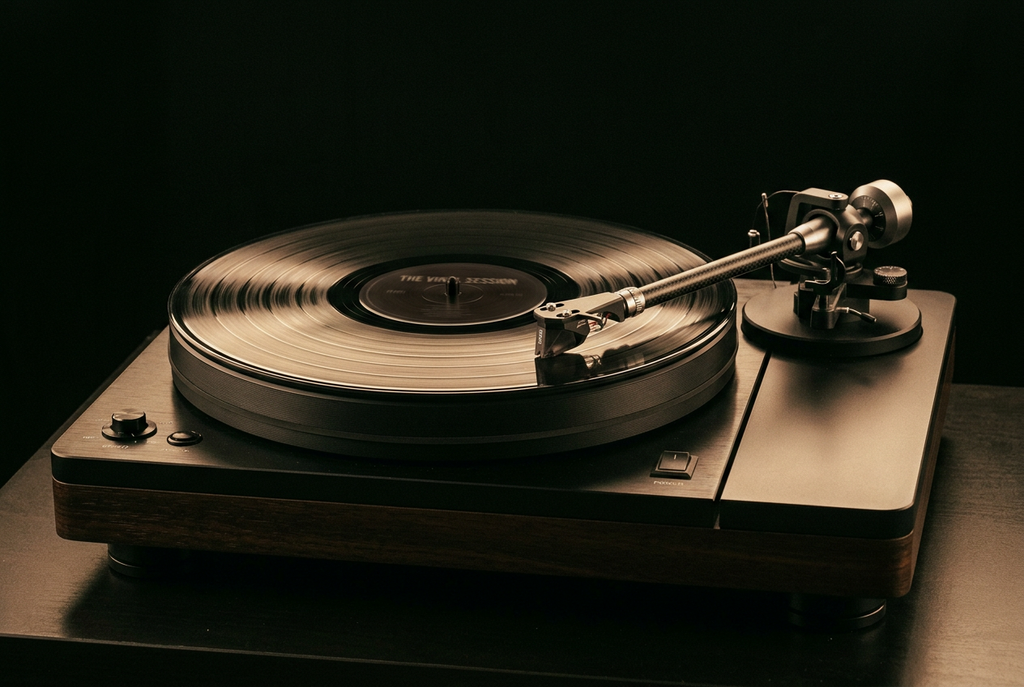
The tonearm is one of the most important components of a turntable.
Its job is to hold the cartridge in the correct position while allowing the stylus to track the record groove with minimal unwanted movement.
A good tonearm should offer:
-
Appropriate effective mass
-
Smooth bearing movement
-
Proper cartridge compatibility
-
Accurate tracking
-
Adjustable tracking force
-
Correct anti-skate control
-
Precise cartridge alignment
Tonearm design becomes particularly important when upgrading cartridges.
A cartridge that performs beautifully on one tonearm may not be the ideal match for another because cartridge compliance and tonearm effective mass interact mechanically.
This is why buying a turntable should be considered as part of a complete system rather than as an isolated purchase.
Cartridge Quality Can Transform the Sound
The cartridge converts the physical movement of the stylus into an electrical signal.
It is therefore one of the most critical components in the analogue signal chain.
Two broad cartridge categories are commonly encountered:
Moving Magnet
Moving Magnet, or MM, cartridges are popular because they offer good performance, relatively straightforward setup, and replaceable styli on many models.
They can be an excellent starting point for listeners entering the audiophile vinyl world.
Moving Coil
Moving Coil, or MC, cartridges use a different generator design and are widely used in higher-end analogue systems.
They can offer exceptional detail, dynamics, imaging, and refinement, although they generally require more careful system matching and an appropriate phono stage.
The most expensive cartridge is not necessarily the best cartridge for every system. Matching matters.
The Platter and Its Role in Sound Quality
The platter provides the rotating platform on which the record sits.
Its mass, material, balance, and construction influence rotational stability and resonance behaviour.
A well-engineered platter should rotate smoothly and maintain consistent speed while controlling unwanted vibration.
Materials used in turntable platters can include:
-
Aluminium
-
Acrylic
-
Glass
-
MDF
-
Composite materials
-
Advanced engineered polymers
Again, the material alone does not determine performance. Engineering, balance, bearing quality, motor control, and resonance management all work together.
Why the Main Bearing Matters
The platter bearing may not receive as much attention as the cartridge, but it plays an important role.
The bearing supports the platter and allows it to rotate smoothly around its central axis.
A precision bearing can help minimise unwanted movement and mechanical noise.
For audiophile listening, mechanical accuracy is important because the turntable must maintain consistent rotation while avoiding unnecessary vibration that can reach the cartridge.
Turntable Isolation Is Often Underestimated
Even an excellent turntable can perform poorly if it is placed on an unstable or vibration-prone surface.
Speakers generate significant acoustic energy. Low-frequency energy can travel through floors, furniture, and walls and potentially reach the turntable.
This can create unwanted feedback and coloration.
A good setup should therefore consider:
-
A rigid and stable surface
-
Distance from speakers where practical
-
Proper isolation
-
Level positioning
-
Appropriate equipment support
For serious listening, isolation is not merely an accessory. It is part of the setup.
Why the Phono Stage Matters
A turntable produces a very low-level signal. That signal needs to be amplified and equalised before it can be properly handled by the rest of an audio system.
This is the job of a phono stage.
Some turntables include a built-in phono preamplifier, while other systems use a separate external phono stage.
An external phono stage can provide greater flexibility for system upgrades and cartridge matching.
The phono stage should be compatible with the cartridge type and its electrical requirements.
MM vs MC: Does the Phono Stage Need to Match?
Yes.
An MM cartridge and an MC cartridge can require different gain and loading characteristics.
A phono stage designed for MM cartridges may not provide the correct electrical configuration for an MC cartridge.
Before upgrading a cartridge, audiophiles should therefore check:
-
Cartridge type
-
Output level
-
Recommended load
-
Phono-stage compatibility
-
Tonearm compatibility
This prevents expensive upgrades from producing disappointing results.
Manual vs Automatic Turntables
Audiophile buyers may also need to decide between manual and automatic operation.
Manual Turntables
Manual models require the listener to position the tonearm and start playback.
They are popular among enthusiasts who enjoy the ritual and control of vinyl playback.
Automatic Turntables
Automatic models can lift, position, and return the tonearm automatically.
They can be particularly convenient for listeners who value ease of use.
Neither approach automatically determines sound quality. A well-engineered automatic turntable can sound excellent, just as a poorly engineered manual turntable can disappoint.
How Much Should You Spend on a Turntable?
There is no universal ideal budget.
The important principle is system balance.
Spending a large amount on a turntable while using an unsuitable phono stage, poorly matched cartridge, or underperforming speakers may not produce the expected improvement.
A better approach is to build a balanced analogue chain:
Turntable → Cartridge → Phono Stage → Amplifier → Speakers
Every component should complement the others.
For someone searching for turntables in Faridabad, this system-based approach can be more useful than simply comparing prices or specifications online.
Are Expensive Turntables Always Better?
Not necessarily.
Higher-priced turntables can offer sophisticated engineering, better bearings, improved motors, superior tonearms, advanced isolation, and more refined materials.
However, price alone does not guarantee a better listening experience.
The ideal turntable depends on:
-
Your existing audio system
-
Your cartridge
-
Your listening preferences
-
Your vinyl collection
-
Your room
-
Your upgrade plans
-
Your budget
A well-matched mid-range system can be far more satisfying than an expensive but poorly integrated setup.
Direct Drive vs Belt Drive: Which Should Audiophiles Choose?
There is no universal winner.
A well-designed belt-drive turntable can provide excellent isolation and musical performance.
A sophisticated direct-drive model can provide exceptional speed accuracy and control.
Instead of choosing based purely on the drive mechanism, evaluate:
-
Motor design
-
Speed regulation
-
Platter construction
-
Bearing quality
-
Tonearm
-
Cartridge compatibility
-
Isolation
-
Serviceability
The overall engineering matters more than the category printed on the specification sheet.
What About USB Turntables?
USB connectivity can be useful for listeners who want to digitise vinyl records.
However, USB functionality should not be the primary reason to choose an audiophile turntable.
If your priority is maximum analogue playback quality, focus first on the mechanical and electrical components responsible for retrieving the signal.
USB output is an additional feature, not a substitute for good turntable engineering.
Common Mistakes When Buying a Turntable
Choosing Based Only on Appearance
A beautiful turntable can be a pleasure to own, but aesthetics should not replace technical evaluation.
Ignoring Cartridge Compatibility
Not every cartridge works optimally with every tonearm.
Placing the Turntable Too Close to Speakers
This can increase the possibility of acoustic feedback.
Skipping Proper Setup
Even an excellent turntable can sound mediocre when tracking force, alignment, anti-skate, or tonearm height is incorrectly configured.
Buying the Most Expensive Model Without Considering the System
A turntable should complement the amplifier, phono stage, cartridge, and speakers.
Neglecting Maintenance
Stylus cleanliness, record cleanliness, belt condition where applicable, and correct setup all contribute to consistent performance.
How to Set Up a Turntable for Better Sound
Once you have selected the right model, setup becomes extremely important.
1. Place It on a Stable Surface
Use a rigid, level platform that minimises unwanted vibration.
2. Level the Turntable
Use a spirit level and adjust the feet if the design allows.
3. Install and Align the Cartridge
Follow the manufacturer's alignment specifications carefully.
4. Set Tracking Force
Use the cartridge manufacturer's recommended tracking force.
5. Adjust Anti-Skate
Set anti-skate according to the cartridge and tonearm manufacturer's recommendations.
6. Check Tonearm Height
Where adjustable, correct tonearm height can help achieve the intended cartridge geometry.
7. Keep Records and Stylus Clean
Dust and contamination can affect playback quality and increase stylus wear.
8. Allow the System to Settle
Once everything is correctly connected and adjusted, spend time listening before making assumptions about upgrades.
How to Choose the Best Turntable for Your Listening Style
Different listeners have different priorities.
If You Love Jazz and Acoustic Music
Look for excellent imaging, tonal accuracy, low noise, and stable speed.
If You Listen to Rock
Dynamics, bass control, tracking ability, and cartridge matching can become particularly important.
If You Listen to Classical Music
Pay close attention to noise floor, speed stability, imaging, microdetail, and dynamic expression.
If You Collect Vintage Vinyl
A cartridge with suitable tracking characteristics and a phono stage with appropriate gain can make a significant difference.
If Convenience Matters
An automatic or semi-automatic model may make vinyl easier to integrate into everyday listening.
Should You Buy a Turntable With a Built-In Phono Stage?
For beginners, a built-in phono stage can simplify the system.
You can connect the turntable directly to an appropriate line-level input and begin listening without purchasing a separate phono preamplifier.
For enthusiasts planning upgrades, however, an external phono stage can provide greater flexibility.
The better option depends on your current system and future plans.
How SoundTrails Can Help You Choose the Right Turntable
Choosing a turntable should be an informed listening decision rather than a specification-sheet exercise.
At SoundTrails, the objective is to help audiophiles understand how different components interact and how those differences translate into actual listening.
When evaluating a turntable, consider the complete signal chain rather than asking only:
"Which turntable is the best?"
A more useful question is:
"Which turntable is best for my system, my records, and the way I listen to music?"
That distinction can make the difference between simply owning a turntable and building a genuinely satisfying vinyl playback system.
Frequently Asked Questions About Audiophile Turntables
Which turntable is best for audiophiles?
The best turntable depends on the listener's system, cartridge, phono stage, budget, and preferences. There is no single model that is ideal for every audiophile.
Does a more expensive turntable sound better?
Not automatically. Better engineering can improve performance, but system matching, setup, cartridge quality, phono-stage performance, and isolation also have a major impact.
Is belt drive better than direct drive?
Neither technology is universally better. Both can deliver excellent performance when properly engineered.
Does the cartridge matter more than the turntable?
Both matter. A good cartridge is essential because it physically reads the information in the record groove, but its performance depends heavily on the tonearm, turntable, phono stage, and setup.
Do I need a separate phono preamp?
Not necessarily. Some turntables and amplifiers include phono stages. A separate phono stage becomes useful when you want greater system flexibility or higher-level performance.
How important is turntable setup?
Extremely important. Cartridge alignment, tracking force, anti-skate, level, isolation, and tonearm adjustment can significantly affect playback.
Can a turntable improve the sound of old records?
A good turntable cannot restore information that is permanently damaged or absent, but a properly set-up system can extract the musical information present in a record more accurately.
Final Thoughts
The best audiophile turntable is not necessarily the most expensive model, the most visually impressive design, or the one with the longest specification sheet.
It is the turntable that provides accurate speed, effective vibration control, a well-engineered tonearm, cartridge compatibility, low mechanical noise, and a strong foundation for the rest of your audio system.
For vinyl enthusiasts, the journey toward better sound is ultimately about precision, compatibility, setup, and listening.
Whether you are upgrading an existing system or buying your first serious record player, take the time to listen, compare, and understand how each component contributes to the final result.
And when exploring turntables in Gurgaon, an experienced Hi-Fi audio specialist such as SoundTrails can help you move beyond specifications and focus on what actually matters: how your records sound in your system.